
Flange seal
What is a flange seal?
In a flanged connection, two components — such as pipe ends or housing halves — are bolted together at their flat end faces. The O-ring sits in a groove in the flange face and is compressed axially when the bolts are tightened. It is a static seal because the components do not move relative to each other in operation. The compression is created by the bolt force that draws the flanges together.
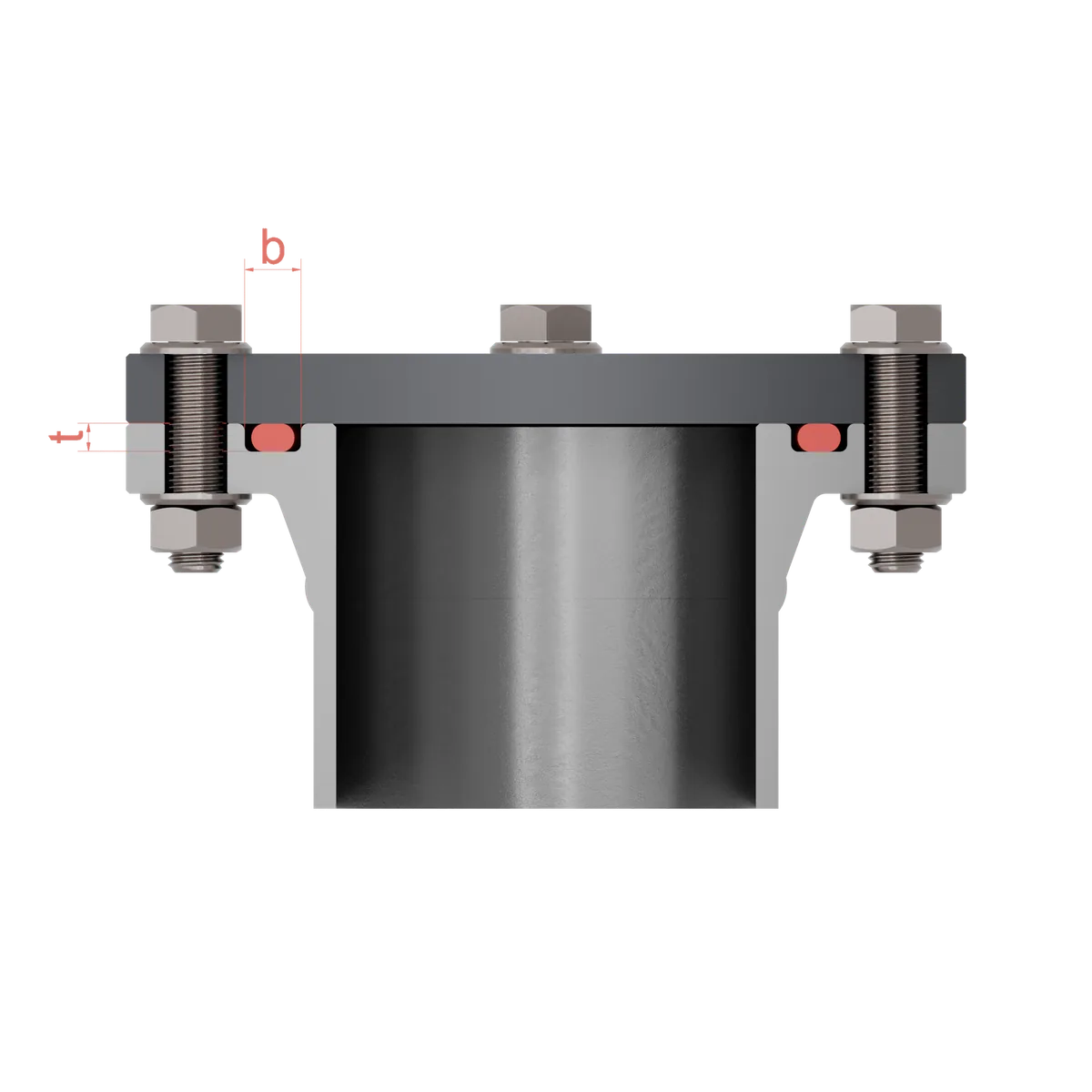
Groove width and depth per cord thickness for flange, piston and rod seals, static and dynamic.
To the O-ring groove-dimensions table →Why the flange seal matters for O-rings
Flanged connections are found in piping, pumps, valves and housings across industry. There the O-ring must withstand pressure, temperature and the medium permanently. Material selection depends on the application: FKM for many industrial media, FFKM for high temperatures and chemically demanding applications. The correct groove depth for sufficient compression and clean sealing faces are also decisive.
- A flange seal statically seals two bolted flanges.
- The O-ring sits in a groove and is compressed axially by the bolt force.
- Material and groove dimensions depend on pressure, temperature and medium.
You'll find the right material for your flanged connection in our range, such as FKM or FFKM. Calculate your groove reliably with our groove calculator.