
ACM O-rings: polyacrylate rubber explained
ACM, the polyacrylate rubber, is a specialist for hot lubricating oils in the automotive sector. We explain its properties, media and temperature resistance as well as the limits of the material with water, steam and fuels.

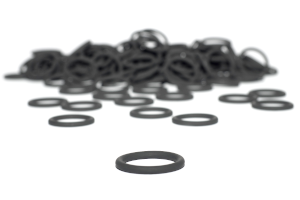
- ACM is the polyacrylate rubber: resistant to hot mineral oils up to 150 °C, a specialist for the drivetrain.
- Main applications are internal combustion engines, automatic transmissions and power steering systems, often with additized ATF oil.
- Continuous temperature range −20 to +150 °C, HT-ACM extends this to −40 to +185 °C. Its low-temperature suitability is weaker than that of EPDM.
- Not resistant to hot water, steam, fuels, polar solvents, acids, alkalis and glycol-based brake fluids.
- ACM is inexpensive but not an all-rounder. In many cases, FKM with its broader profile and higher heat resistance is the more robust choice.
What are ACM O-rings?
ACM, the polyacrylate rubber, stands out from the crowd of sealing materials with one property: O-rings and other sealing elements made from this material are resistant to attack by mineral oils even at high temperatures of up to 150 °C.
This makes the material particularly interesting for use in the automotive sector. In the drivetrain of conventionally powered vehicles, heavily additized lubricants meet high temperatures. This applies especially to the engine and transmission, where polyacrylate not only seals expansion tanks, covers or lines as a moulded part, but is also used as a liquid sealant for machine application.
For high-volume use, polyacrylate is also attractive because its price level is significantly lower than that of HNBR and FKM.
O-rings made of polyacrylate are given the short designation ACM in accordance with ISO 1629. The nomenclature according to ASTM D 1418 does not differ from this either. Users are also often familiar with the trade names of major manufacturers, including HyTemp®, Noxtite® and Hycar®.
The 5 most important advantages of ACM O-rings
- Very good resistance to ozone and hot air
- Inexpensive sealing material
- Very good suitability for outdoor use
- Resistant to hot heating oil and lubricating oil
- Low gas permeability
Automotive engineering is the dominant field of application for ACM O-rings. Here the sealing material benefits from its most important advantages: resistance to hot lubricating oils and insensitivity to weathering.
In contact with rubber, oils can lead to changes in the material properties. This must be prevented as far as possible in order to maintain the sealing effect of O-rings over the long term. With less suitable materials, the medium penetrates the sealing material and causes an increase in volume.
As a result, the material cohesion of the seal can be impaired. This leads to softening, which above all makes the sealing element more sensitive to pressure. At the same time, the increased volume results in increased friction in dynamic sealing applications.
ACM O-rings show very good swelling behaviour in oil and remain stable in their properties. Their durability is also aided by their insensitivity to weathering and ageing: hot ambient air, moisture or ozone sources can hardly impair the sealing-relevant properties of ACM.
The 3 most common areas of application for ACM O-rings
Internal combustion engines
SAE engine oils are used to lubricate internal combustion engines. In these systems, ACM O-rings handle the sealing of the oil filter, for example. Depending on the operating time and load, the sealing elements come into contact with temperatures between −40 and +150 °C.
ACM O-rings have the necessary cold flexibility and heat resistance to maintain the sealing effect across this wide temperature band. ACM is not alone in this, however: NBR, HNBR and FKM are also suitable for this application. FKM even offers higher maximum continuous temperatures.
Automatic transmissions
In automotive transmissions, temporary maximum temperatures of up to 150 °C can be expected. On a continuous basis, however, the operating temperature is around 90 °C. Lubrication is provided by so-called ATF oil (Automatic Transmission Fluid). ACM O-rings offer a very good match for the medium and temperature range.
The numerous additives in modern ATF oils do not reduce the durability of ACM seals either.
Power steering
Similar operating conditions to those in automatic transmissions can be found in the power steering unit. Here, too, the maximum temperature peaks are at 150 °C. ATF oils are sometimes used as the hydraulic fluid.
As with the other applications, ACM O-rings are replaced by their FKM or HNBR counterparts when particularly high temperatures are expected.
Distinction from AEM
AEM, the ethylene-acrylate rubber, should not be confused with ACM. It is a material that resembles ACM in many properties and is also very widespread in the automotive sector.
AEM differs from ACM in its better heat resistance. At the same time, the lower mineral oil resistance of AEM has a disadvantageous effect. The material is used primarily for the manufacture of hose applications, seals for the engine and transmission as well as components for turbochargers.
Media resistance of ACM O-rings
Unlike FKM or HNBR, ACM does not have a particularly comprehensive resistance profile. O-rings made of ACM are therefore less universally usable and are limited to specific fields of application.
In contact with mineral-oil-based products for lubrication or hydraulics, however, ACM O-rings are very capable. This is especially true given the good cost-effectiveness of the material.
| Resistant to | Not resistant to |
|---|---|
| Highly additized lubricating oils | Hot water |
| Ozone, weather and hot air | Steam |
| Mineral oils | Fuels |
| Polar solvents such as acetone | |
| Aromatic hydrocarbons | |
| Glycol-based brake fluids | |
| Acids, alkalis | |
| Amines | |
| Hydraulic fluids (HFA, HFB, HFC, HFD) |
As far as media resistance is concerned, the swelling behaviour of ACM O-rings in mineral oils is particularly worth highlighting. The medium can not only cause other sealing materials to swell, with the loss of elastic properties and increased friction as consequences.
Less resistant materials also lose their sealing properties because mineral-oil-based media dissolve compound constituents out of the material. ACM, by contrast, shows very good swelling behaviour, so that its elastic and other mechanical properties remain stable over the long term.
You will find an overview of how different materials behave towards specific media in our resistance table.
Temperature resistance of ACM O-rings
Data sheets for standard ACM grades specify a general temperature range of −20 to +150 °C. In each case, this is the maximum permissible continuous temperature. In the region of the upper application limit, short-term temperature peaks of up to 150 °C are possible.
Above that, the service life of ACM O-rings suffers greatly, so that a different material should be used. The temperature range of ACM is similar to that of EPDM, although the low-temperature suitability of ACM is less pronounced.
At very low temperatures, ACM O-rings lose their flexibility more quickly, so that they can no longer reliably cover a changing sealing gap. This makes leakage more likely, for example when pressure conditions change or under impacts from outside.
When it comes to heat suitability, there are clearly superior materials, including VMQ, FVMQ, FKM and FFKM. They maintain a low compression set even at temperatures above 150 °C.
In the relevant application range in air and mineral-oil-based lubricants, however, ACM O-rings offer good application possibilities up to the maximum temperature of 150 °C. With hot water or steam, by contrast, the material is not resistant.
In the meantime, the market offers so-called HT-ACM O-rings. They cover an extended temperature range and work reliably on a continuous basis up to the limits of −40 and +185 °C respectively.
Mechanical properties of ACM O-rings
- Suitable for static and dynamic use
- Medium strength
- Low elasticity
- Good mechanical load-bearing capacity
- Poor dry-running properties
In principle, ACM is suitable for both static and dynamic sealing. ACM O-rings owe their dynamic application possibilities above all to their good swelling behaviour and physical properties.
Because the material shows hardly any changes in volume during use, the friction conditions remain constant over long periods of operation. At the same time, the low abrasion resistance has a limiting effect, so that dry running should be avoided. When selecting suitable lubricants, media compatibility must in turn be taken into account.
Groove design and installation of ACM O-rings
Groove design
- Compression in the groove should be approx. 20 % for static use
- Choose a lower compression for dynamic sealing
- 20 % of the groove should still be free after compression
- Always design grooves according to the standard tables common in the market
- Permanent stretch after installation should be below 6 %
- Permanent compression after installation should be below 6 %
Installation
- Thoroughly clean the groove space before installation
- Do not stretch elastic O-rings by more than 50 % during installation
- Provide lead-in chamfers of between 15 and 20 degrees
- Deburr bores, even if they are only passed over during installation
- Round off sharp edges with a minimum radius of 0.1 to 0.3 mm
- Use suitable lubricants to ease installation
- Avoid twisting the O-ring
Common questions
What is ACM made of?
What are ACM O-rings used for?
What temperature range do ACM O-rings cover?
Are ACM O-rings resistant to water?
What is the difference between ACM and AEM?
Why is ACM used less often than FKM?
