
Avoiding gap extrusion in O-rings
High and pulsating pressure can press O-rings into the sealing gap and shear off material. This is how the gap extrusion failure pattern arises, how you recognise it and how you avoid it through material, design and back-up rings.

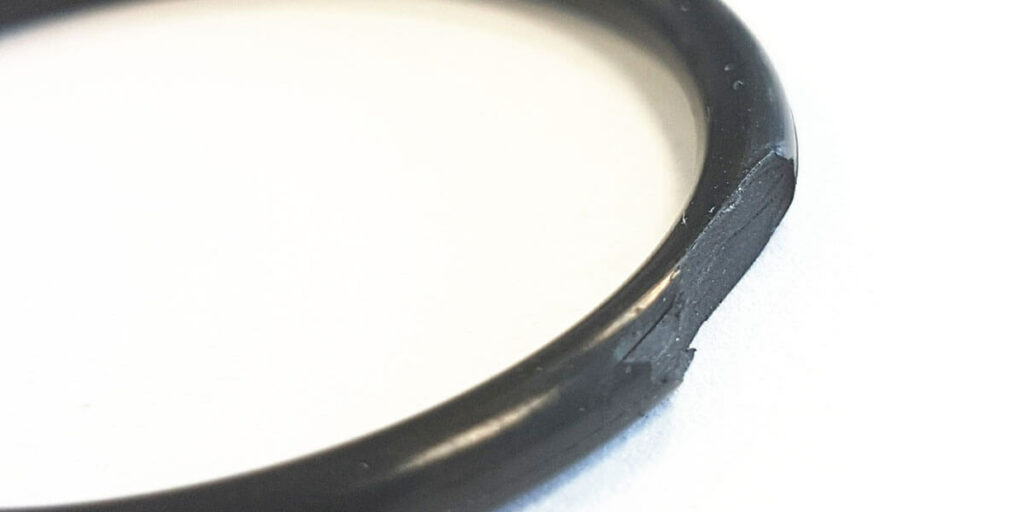
- Gap extrusion occurs when high pressure presses the nearly incompressible O-ring into the sealing gap between piston and cylinder.
- The groove edge shears thin layers of material off the O-ring, usually at the point with the largest gap dimension.
- High and especially pulsating pressure, high temperatures, large sealing gaps and sharp groove edges increase the risk.
- Harder and stiffer materials, larger cord thicknesses and back-up rings on the side facing away from the pressure provide a remedy.
- If material selection is not enough, design measures follow, such as a tighter sealing gap and radii instead of chamfers.
Gap extrusion: a hazard for O-rings under pressure
Gap extrusion is one of the most prominent failure patterns of O-rings. This is mainly due to the very distinctive peeling on the elastomer. It clearly illustrates the loads to which O-rings are exposed under harsh operating conditions. Cyclically alternating phases of very high and lower pressure are the main cause of the damage.
In hydraulics in particular, gap extrusion is therefore one of the common causes of failure for O-rings. In this article you will learn how gap extrusion occurs and how maintenance staff recognise the failure pattern. At least as important for the practitioner: we provide an overview of the factors that promote gap extrusion. From this follows the most effective strategy against gap extrusion. To read how pressure acts on the seal in general, see the article on O-rings under pressure.
The failure pattern of gap extrusion
In the technical literature, the phenomenon of gap extrusion also appears under the terms extrusion, gap migration or squeeze-out. The principle behind it is simple: O-rings made of elastomers have almost no compressibility. As the pressure rises, the O-ring increasingly takes on the contour of the installation space. Since the O-ring cannot be compacted, the pressure eventually presses it into the sealing gap between piston and cylinder.
This process leaves very characteristic peeling on the sealing element. The edge of the groove shears a thin layer off the surface of the O-ring. This usually does not happen in a perfect circle, but mainly at the point with the largest gap dimension. If the piston and cylinder are not precisely concentric to one another, the sealing gap takes on different widths along the circumference. Under particularly unfavourable configurations of the sealing system, however, the O-ring can also roll over its entire circumference.
Depending on how high the prevailing pressure is and how the sealing system is designed as a whole, the length of the extrusion tail can reach a multiple of the cord thickness. With rapidly changing pressure conditions, parts of the extruded material can also be separated from the O-ring. These particles pose a risk to sensitive processes. They can contaminate the process media or damage other system components.
Causes of gap extrusion
Gap extrusion is caused by the mechanical load on the O-ring during operation. In practice, mechanical and physical influences on the sealing element are responsible for most seal failures. Alongside gap extrusion, this category also includes damage from assembly errors or inadequate groove design as an important factor. The article on the causes of failure in O-rings gives an overview of the various categories.
The description of the failure pattern has already made it clear. These factors are particularly decisive for the risk of gap extrusion:
System pressure
In gap extrusion, high and pulsating pressure causes the stress. It is not only the level of the maximum pressure but also the speed at which pressure changes occur that influences the load on the O-ring. Sudden pressure surges cause an increased risk of gap extrusion.
The seal can offer little resistance to rapidly occurring deformation. Such a sudden pressure build-up occurs very frequently in hydraulic systems. In vehicle components, such pressure surges can arise, for example, from sudden braking or from abrupt changes of direction.
Operating temperature
In addition, the resistance to deformation of elastomers varies greatly depending on the temperature. O-rings at hot temperatures can offer less resistance to the load than sealing elements in cooler environments.
If extreme temperature peaks are added to high operating pressure, gap extrusion is particularly likely. This applies at least when the designer does not plan any protective measures during the design.
Design
Here the interplay between the size of the sealing gap, the design of the groove recesses and the dimensions of the O-ring is decisive. Coordinating these factors is the basic prerequisite for function even with static seals. For dynamic seals, which have an even higher risk of gap extrusion, this design aspect is critical.
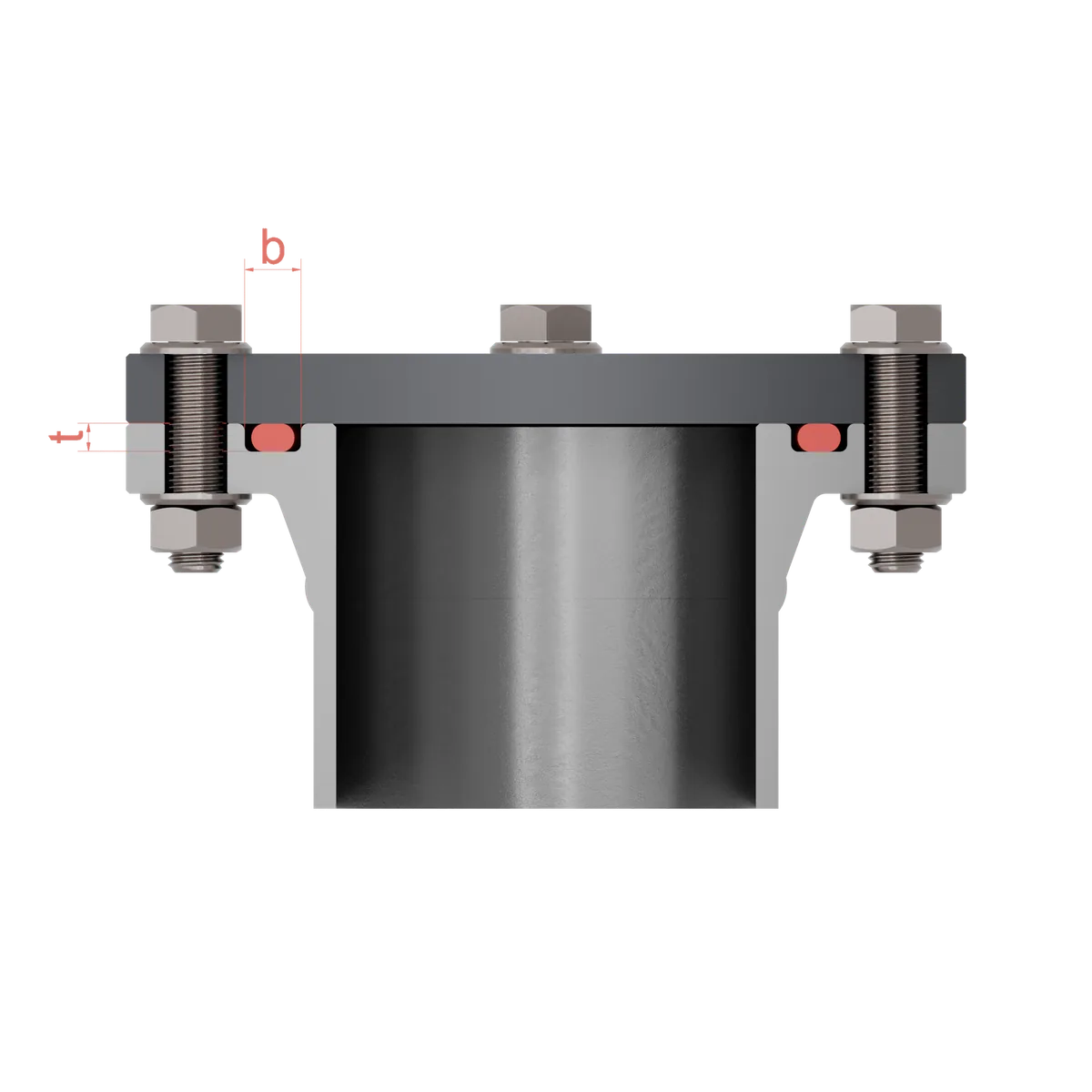
The danger of gap extrusion also increases with the size of the sealing gap. The problem: achieving tighter tolerances on the components involved leads to higher manufacturing costs. In addition, the components can change their shape under the effect of pressure and temperature. In unfavourable cases, the maximum sealing gap can amount to the entire diametric clearance. This applies when the piston and cylinder are positioned at the maximum off-centre position relative to one another.
There is also the design of the groove edges. A sharp edge shears the O-ring off particularly easily as it enters the gap. The designer should therefore provide a radius for the groove recesses. Cord thicknesses that are too small make O-rings susceptible to gap extrusion. Although the pressure presses even thicker O-rings into the sealing gap, they withstand material removal for longer. Read the basics of correct groove design in the article on O-ring grooves.
Material selection
Choosing a harder O-ring is the standard recommendation for applications at risk of extrusion. In reality, however, it is above all the stiffness of the seal that protects it from being pressed into the gap. The modulus of elasticity of the O-ring under various ambient conditions is often not available. Hardness is therefore an important indication of the extrusion resistance of an O-ring material. How Shore hardness is measured and what it tells you is explained in a separate article.
Materials whose mechanical properties decline significantly as the temperature rises are very susceptible to high pressures. The stress from the process media should also be taken into account during material selection. Damage from swelling and shrinkage reduces the seal's resistance to gap extrusion.
How to secure O-rings against gap extrusion
Knowledge of the operating principle of gap extrusion and its causes is the crucial basis for successful prevention. Designers who create sealing systems should therefore be as thoroughly informed as possible about the behaviour of elastomer materials under demanding operating conditions. Only then will they recognise sealing cases with a particularly high risk of gap extrusion and be able to take countermeasures during the design.
When selecting the material, O-rings with higher hardness and strength should be given preference. Resistance to the process media used is always a prerequisite. Where it suits the application, O-rings made of thermoplastics are an alternative.
Further options arise from the use of moulded seals or back-up rings. Moulded seals can be provided with a fabric reinforcement bonded on during vulcanization. This makes the seal stiffer. Designers pursue a similar principle with the use of back-up rings. They are not firmly connected to the O-ring. Instead, the fitter installs them in front of the O-ring on the side facing away from the pressure. If the pressure acts alternately from both sides, a back-up ring is used on each side.
The components themselves have no sealing effect but prevent the O-ring from migrating into the gap. They are available with the most varied profiles in slotted or closed designs. This allows them to adapt to the installation situation and the operating conditions. The standard material for back-up rings is PTFE, but POM or PA are also found.
If the options in material selection have been exhausted without the desired success, the preventive measures become more elaborate. Further starting points are reducing the sealing gap and finer machining of the groove. Instead of chamfers, the designer should use radii. However, achieving tighter tolerances and precise radii requires increased manufacturing effort. The decision must be made on a case-by-case basis as to which combination of preventive measures most efficiently prevents gap extrusion.
Support for critical operating conditions
Operating conditions that are very challenging for O-rings require a particularly careful design of the entire sealing system. This includes the selection of the sealing material as well as the definition of the cord thickness and the design of the groove. The simplest way to ease the situation would of course be to reduce the system pressure. In gap extrusion, this is the most problematic factor.
However, since the pressure ranges are usually dictated by other dependencies, the designer should make all the better use of the remaining degrees of freedom. Various elastomer compounds with or without a back-up ring, the cord thickness and the design of the installation groove offer effective approaches to limiting the risk.
Frequently asked questions
What is gap extrusion in O-rings?
How do I recognise gap extrusion?
Which factors promote gap extrusion?
How do back-up rings prevent gap extrusion?
Does a harder O-ring help against gap extrusion?
Which design measures reduce the risk?
